
CRISPR/Cas9 is a programmable genome editing system in which a guide RNA directs the Cas9 nuclease to a specific DNA sequence, where the enzyme introduces a double strand break that the cell then repairs. In practice, the mechanism unfolds in three steps: recognition, cleavage, and repair. The designed single guide RNA (sgRNA) recognizes its target next to a short motif called the protospacer adjacent motif (PAM), Cas9 cuts roughly three to four base pairs upstream of an “NGG” PAM, and the cell’s own repair machinery resolves the break, which is where an edit is introduced.
That simplicity of design is why the system has reshaped genomics research and is now central to therapeutic development. Understanding each step, and how the components interact, helps researchers, clinicians, and regulatory stakeholders evaluate what a given edit can and cannot achieve. The regulatory landscape is also moving. The FDA’s June 2026 draft guidance describes how sponsors of human gene therapy products using genome editing in human somatic cells can draw on publicly available information and established platform knowledge, including CMC data, nonclinical results, and clinical information, to streamline submissions. This article walks through the mechanism, its core components, and its healthcare applications, with attention to the ethical and practical considerations that responsible progress in this field requires, including delivery, which remains an open consideration.
What CRISPR/Cas9 Gene Editing Means in Plain Terms

CRISPR-Cas9 is best understood as a two-component system. A guide RNA directs the Cas9 enzyme to a specific DNA target, and Cas9 then cuts at that site. The target must sit next to a short recognition motif called a PAM sequence, which Cas9 requires before it will bind and cleave. Because the guide RNA can be redesigned to match different sequences, the system is programmable in a way earlier nucleases were not.
For genomic medicine, that programmability is the point. Many genetic disorders trace back to changes at defined locations in the genome, so a tool that can be aimed at a chosen locus lets researchers model those changes and explore corrective strategies. Precise cleavage matters because the downstream outcome depends on where the cut lands.
A few terms recur throughout this article, so it helps to fix them early:
- CRISPR
- A family of DNA sequences and associated components adapted from bacterial defense systems, now used as the basis for programmable genome editing tools.
- Cas9 nuclease
- The enzyme that cuts DNA once it is directed to a target by a guide RNA.
- Guide RNA (sgRNA)
- A designed RNA molecule that recognizes the target sequence and leads Cas9 to the matching genomic region.
- PAM sequence
- A short motif adjacent to the target site, commonly NGG for the widely used Cas9, that must be present for cleavage to occur.
- Double-strand break (DSB)
- A cut across both strands of the DNA helix, made three to four base pairs proximal to the PAM, which the cell must then repair.
Genome editing, in this context, refers to making deliberate changes to a cell’s DNA. CRISPR-Cas9 accomplishes this by creating a defined break and relying on the cell’s own repair processes, a sequence we follow step by step next.
How the CRISPR Mechanism Works: Recognition, Cleavage, and Repair
Step One: Guide RNA Recognition and PAM Dependence
Recognition begins with the single guide RNA (sgRNA), which pairs with a complementary stretch of genomic DNA. The sgRNA carries a programmable targeting sequence, and that sequence determines where the Cas9 nuclease is directed. Because of this, retargeting the system to a new locus mainly requires redesigning the guide rather than re-engineering the protein.
Base pairing alone does not license a cut. The Cas9-guide RNA complex must first locate a protospacer adjacent motif (PAM), which for the commonly used Cas9 is the sequence NGG, where N is any nucleotide. The NGG PAM requirement acts as a prerequisite for binding and cleavage. The PAM sits next to the target, and the double-strand break falls three to four base pairs proximal to it.
This dependence has practical consequences for design. A target site is only usable if a suitable PAM lies immediately beside it, which narrows the editable portion of the genome. When a mutation of interest sits far from an NGG motif, researchers may find that the available guide positions do not align well with the desired edit.
For experimental and therapeutic planning, PAM availability should be assessed early, alongside guide selection. Teams that share target-site annotations and design constraints across disciplines can spot these limits sooner and avoid costly redesign later in the workflow.
Step Two: Cleavage and the Double-Strand Break
Once the Cas9-guide RNA complex has locked onto a target adjacent to the PAM, the Cas9 nuclease does the work it is named for: it cuts the DNA. The sgRNA directs Cas9 to create a double-strand break (DSB) three to four base pairs proximal to an “NGG” PAM sequence, which means the system cleaves near the NGG PAM at a predictable, defined position rather than at random.
That predictability matters. Because the break lands at a consistent distance from the PAM, researchers can design a guide so the DSB falls at, or very close to, the site they intend to modify. A cut placed even a few bases off target may fall outside the sequence of interest and change what the cell’s repair machinery ends up doing with it.
For teams working toward therapeutic applications, this positional precision is a practical design constraint, not a footnote. It shapes how guides are selected, how editing outcomes are characterized, and how results are compared across laboratories. Clear shared standards for describing cut sites help clinicians, researchers, and reviewers read one another’s data on equal terms, which is the foundation for collaborative progress in genomic medicine.
Step Three: Cellular Repair and Editing Outcomes
Once Cas9 has produced the double-strand break, the third step of the mechanism, repair, falls to the cell itself. Cas9 supplies the cut but not the outcome. Cells treat a double-strand break as serious damage and respond with their own endogenous repair machinery, and the pathway that engages largely determines what the final edit looks like.
At a conceptual level, the cell can resolve the break in more than one way. One route simply rejoins the broken ends, a process that can leave small sequence changes at the cut site. Another route uses a repair template to guide the restoration of the DNA, which makes more deliberate sequence changes possible. Which pathway predominates depends on the cellular context, and it is generally not something an experimenter controls completely.
This is why the repair phase deserves as much attention as recognition and cleavage. The same guide RNA and Cas9 pairing can, in principle, give rise to a range of editing outcomes, so a single intended edit is rarely the only result at a given site. For researchers and clinicians, that variability makes careful characterization of the resulting sequences a core part of any editing workflow, and it is a natural area for shared methods and data across groups.
The Components of the CRISPR/Cas9 Complex
The active CRISPR/Cas9 complex is built from three parts that must come together before any DNA is cut. The system is commonly described as a two-component platform, a guide RNA plus the Cas9 enzyme, but the target’s PAM context is the third element that determines where that pair can actually act.
- Cas9 nuclease: the protein that cuts the DNA.
- Single guide RNA (sgRNA): the designed RNA that directs the complex to the matching target sequence.
- PAM (protospacer adjacent motif): the adjacent sequence motif that must be present for cutting to occur, typically NGG for the commonly used Cas9.
Assembly follows a logical order. A Cas nuclease, depicted as Cas9 in most mechanistic schematics, forms a complex with the guide RNA, and that ribonucleoprotein then engages the genomic region it has been programmed to find. The sgRNA supplies the sequence specificity, while the protein supplies the catalytic activity. Neither is sufficient alone: without the guide, Cas9 has no address, and without the nuclease, the guide has no means of altering the DNA.
The PAM-adjacent context is easy to overlook because it is a feature of the genome rather than a part of the reagent. Cas9 cuts only where the target sits next to the appropriate motif, so the PAM effectively defines which sites are addressable. For experimental and therapeutic design, this means candidate targets have to be evaluated against PAM availability from the outset. Once the complex is positioned, the sgRNA guides Cas9 to create a double-strand break three to four base pairs proximal to an NGG PAM.
Other Cas nucleases exist, and they are the subject of ongoing research and discussion across the field. This overview stays with Cas9 as the reference system, since it anchors most of the mechanistic literature that interdisciplinary teams draw on when planning collaborative work.
How CRISPR Editing Is Used in Research and Healthcare
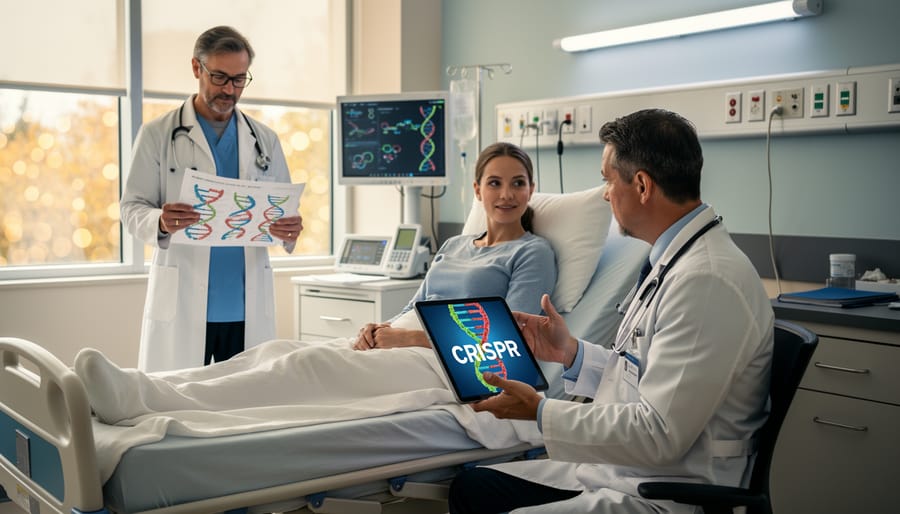
CRISPR/Cas9 gives researchers a programmable way to cut a chosen DNA sequence, and that single capability underlies most of its current uses. In the lab, the same recognition-cleavage-repair mechanism that makes the tool precise also makes it a practical instrument for asking what a gene actually does. Clinically, the interest lies in applying that precision to genetic disorders, with an appropriately cautious pace.
The main application areas break down as follows:
- Basic research and disease modeling: altering genes in cells or model systems to reproduce disease-associated variants, which helps clinicians understand how a mutation drives pathology.
- Target validation: disrupting a candidate gene to test whether it matters for a disease process, which informs which therapeutic targets merit further investment.
- Somatic-cell therapeutic development: designing edits in a patient’s non-heritable cells to correct or compensate for a causative variant, with the aim of treating the underlying genetic cause rather than only its symptoms.
These areas build on one another. Models and validation studies generate the evidence that justifies therapeutic programs, while clinical observations feed back into better models. That loop works best when researchers, clinicians, and funders share methods and data openly, rather than each group working in isolation.
Clinical translation also depends on reliable genomic information. Teams that can diagnose genetic diseases accurately are better positioned to identify which patients and which variants could plausibly benefit from an editing strategy. For a broader view of how these approaches relate to clinical practice, see our overview of CRISPR in humans.
Moving from bench to bedside still involves open questions. How an editing system reaches the intended cells in a patient remains an active consideration in translation, and it shapes which conditions are realistic early candidates. Treating that uncertainty openly, rather than glossing over it, is part of responsible progress in the field.
Regulatory Context: The FDA’s 2026 Draft Guidance on Genome Editing Therapies
On June 2, 2026, the FDA issued draft guidance intended to help developers bring promising gene therapies to patients more efficiently by making greater use of existing scientific and regulatory knowledge. For teams working with the recognition, cleavage, and repair mechanism described above, the practical message is that prior understanding of a platform can carry weight in a submission rather than being rebuilt from scratch each time.
According to the draft, sponsors can use publicly available information and established platform knowledge to streamline regulatory submissions for human gene therapy products that use genome editing in human somatic cells. That knowledge includes chemistry, manufacturing and controls (CMC) data, nonclinical study results, and clinical information. A sponsor who can articulate how the guide RNA, the Cas nuclease, and the PAM-dependent targeting behave as a system is better positioned to explain what carries over from earlier work and what is genuinely new.
Two cautions apply. This is draft guidance, so its contents may change, and readers should consult the FDA’s own documents for specifics before building a development plan around it. Reuse of established knowledge also depends on information being accessible, which gives researchers, clinicians, and developers a shared reason to document and share methods and findings carefully. For broader context on how the field is shifting, see our overview of gene therapy updates 2026.
Ethical Considerations and Current Limitations
Responsible use of CRISPR starts with the distinction between somatic and germline editing. Somatic edits affect only the treated individual, while germline changes would be heritable, which raises far heavier questions about consent for future generations and about oversight. That is why current regulatory attention, including the FDA’s June 2026 draft guidance, centers on human somatic-cell genome editing.
Access and consent deserve equal weight. If a therapy built on this mechanism reaches only well-resourced health systems, the technology widens the very disparities it hopes to narrow. Patients also need plain-language explanations of what an edit can and cannot do, including uncertainties that remain unresolved, such as how best to deliver editing components to target tissues.
The technical constraints are just as real. Because Cas9 requires a PAM sequence such as NGG next to its target, some genomic sites are harder to reach, which shapes both experimental design and therapeutic ambition. Every edit also needs rigorous characterization, confirming what changed, where, and in how many cells, rather than assuming the guide RNA acted only as intended. Here, fields like computational genomics help us design guides and interpret outcomes more carefully.
None of this can be settled by any one lab. Transparent data sharing, open dialogue with clinicians and patients, and shared standards are obligations the whole research community carries together.
CRISPR/Cas9 Mechanism: Frequently Asked Questions
How does CRISPR/Cas9 work?
CRISPR/Cas9 is a two-component system in which a guide RNA directs the Cas9 enzyme to a specific DNA target adjacent to a PAM sequence. Cas9 then cuts the DNA, and the cell’s own repair machinery resolves the break.
What are the steps in CRISPR/Cas9 genome editing?
The mechanism contains three steps: recognition, cleavage, and repair. The designed sgRNA recognizes the target sequence, Cas9 creates a double-strand break, and the cell then repairs that break.
What does sgRNA do, and what is a PAM sequence?
The sgRNA guides Cas9 to the intended genomic site by pairing with the target sequence. The PAM is a short sequence next to that site, and for the commonly used Cas9 it is “NGG”; Cas9 cuts three to four base pairs proximal to it.
How does the FDA streamline genome editing therapy submissions?
In draft guidance issued on June 2, 2026, the FDA states that sponsors can use publicly available information and established platform knowledge to streamline submissions for human somatic-cell genome editing products. This includes chemistry, manufacturing and controls (CMC) data, nonclinical study results, and clinical information.
Because the guidance is still a draft, we encourage readers to consult the FDA’s own documents for specifics. The mechanistic questions above also remain active areas of collaboration among researchers, clinicians, and regulators. Delivery methods, for example, continue to be an open consideration in translation, and we have intentionally left them outside the scope of this overview.
CRISPR/Cas9 works through a clear sequence. The guide RNA recognizes a target adjacent to a PAM, Cas9 cuts the DNA to create a double-strand break, and the cell’s own repair machinery resolves it. That elegance is what makes the system so valuable for healthcare, where programmable editing offers a rational route toward understanding and addressing genetic disorders.
Mechanistic fluency is only part of the work, though. Responsible progress also depends on ethical stewardship, from the somatic versus germline distinction to informed consent and equitable access. It also depends on regulatory awareness. The FDA’s June 2026 draft guidance signals that established platform knowledge can streamline submissions, which rewards developers who share and build on solid evidence.
None of this advances in isolation. We invite researchers, clinicians, and funders to engage with the Genetic Innovation community, exchange findings, and help move responsible genome editing forward together.